
Residents in southeastern Pennsylvania will have an opportunity to get rid of their old, gasoline-powered lawn mowers and purchase environmentally friendly, discounted electric or battery-powered mowers at an event on Saturday, May 7 in Springfield Township, Montgomery County.
Hosted by the Air Quality Partnership (AQP), a program to reduce air pollution in the region, the event will be held:
Saturday, May 7
10:00 a.m. to 2:00 p.m.
Springfield Township High School parking lot
1801 East Paper Mill Road, Erdenheim, PA.
Interested residents can pre-register at http://www.airqualitypartnership.org/. The first 140 registrants will receive a $50 voucher toward a new, electric or battery-powered lawn mower.
Black and Decker will be on-site, giving up to an additional 30% off to those who purchase a mower at the event. Participants must trade-in an old mower in order to receive the voucher and discount. Registration will close at 250 participants.
The AQP is partnering with Sustainable Waste Solutions (SWS) to haul away the old mowers. All mowers must be drained of fluids before drop-off. A list of county hazardous waste days can be found at www.airqualitypartnership.org.
AQP is a program of the Delaware Valley Regional Planning Commission (DVRPC), which educates residents about the dangerous effects of ground-level ozone, and provides air quality forecasts to the public. Gas-powered lawn mowers are a major contributor to ground-level ozone, and purchasing an electric mower is just one way the public can help the environment. To sign-up for air quality forecasts and alerts, and for tips on how to reduce air pollution, visit the newly redesigned website, www.airqualitypartnership.org.
Sustainable Waste Solutions, LLC, an environmentally green recycling and solid waste services company, is the first landfill-free waste company in our region. Its focus is converting trash to renewable energy. Headquartered in Montgomery County, Pennsylvania, Sustainable Waste Solutions serves its clients throughout Southeastern Pennsylvania, Lehigh Valley and Delaware.
Friday, April 1, 2011

Friday, February 18, 2011
GVF's 2011 Sustainable Awards - Submit Application Now!

Take a moment to view the application by clicking here or visit http://www.gvftma.com/, to see how you qualify for either the Bronze, Silver, Gold or Platinum recognition level. Upon review of the application, partners will be recognized at GVF’s Fall Partner Breakfast, which will be held in September 2011.
If you have any questions, please do not hesitate to contact us. We look forward to receiving your applications!
Thursday, February 10, 2011
GSK moving Philadelphia operations to Navy Yard
 GlaxoSmithKline (GSK), one of GVF's partners, is relocating its Center City operations to the Philadelphia Navy Yard. It will move about 1,300 downtown employees to the South Philadelphia site.
 Liberty Property Trust, another one of GVF's partners, will construct a 205,000-square-foot “state-of-the art workplace of the future” for the pharmaceutical company, said John Gattuso, senior vice president and regional director at Liberty, a Malvern, Pa., real estate investment Trust. Robert A.M. Stern Architects will design the $81 million, four-story building, which will be built to meet a LEED platinum designation.
“The reason it is at the Navy Yard is the company wanted a very specific environment that had a main street and that’s not a configuration that could be adapted in a current building or built in Center City,” Gattuso said. “That is the driver of the selection of the Navy Yard.”
GSK said the building will have an open plan design, which is consistent with other GSK facilities designed to bring employees together to foster better communication and idea sharing. The building will have a fitness center, restaurant, retail services, and free parking for employees and visitors. To read the entire article from the Philadelphia Business Journal, click here.
GVF is pleased to see two of its partners working together on this sustainability initiative and look forward to seeing the outcome. Among many notable awards, Liberty Property Trust was recognized in 2010 with GVF's Sustainable Awards. Through GVF's Climate Change Task Force, GVF has offered a tour of Liberty Property's Tasykake Bakery, which was built with several features in order to target LEED-Silver certification.
Would you be interested in visiting the LEED platinum GSK building once it is open? Let us know by emailing info@gvftma.com or calling 610-354-8899, so we can see if a possible tour would be feasible.
Thursday, January 27, 2011
New Bar Being Set for Higher Ed Sustainability
GVF currently partners with Montgomery County Community College, St. Joseph's University and Philadelphia College of Osteopathic Medicine and provides our professional expertise by participating on MCCC's transportation committee, which was implemented when Dr. Stout signed the American College & University Presidents' Climate Committment, and SJU's transportation committee, which was implemented after President Lannon created the Committee on Sustainability. It is exciting to be a part of these committees and assist MCCC and SJU to become more sustainable and setting benchmarks for future initiatives.
Below is an article from the Keystone Edge regarding Chatham University, located in Pittsburgh, which has taken on a decidedly green approach to education.
That has become evident in recent years with the establishment of its School of Sustainability and the Environment, the hiring of its first sustainability coordinator and the addition of an Environmental Biology track to its Master of Science in Biology program.
Chatham recently announced its latest and most ambitious sustainability initiative yet: the nation's first university campus to integrate sustainable development, living and learning.
 Chatham's Master Plan to develop the Eden Hall Campus in nearby Richland Township calls for the School of Sustainability and the Environment - the second of its kind in the U.S. - to be housed there on a 388 acre site north of the school's Shadyside Campus.
The new campus will be able to handle 100 students, which is expected to increase to 1,500 in the next decade, and will include four districts:
Mueller Center Campus-Restoration and preservation of existing facilities, construction of academic and residentail facilities and landscape restoration, with long range plans for an EcoCenter, commons building, greenhouse, agricultural fields, amphitheater, sports complex, constructed wetlands and art studio.
Elsalma Center-Interaction with the public on northwest corner of campus through a conference center, teaching kitchen, classrooms/workshops, orchard, farm market, aquaponics and wellness center.
Stanford Hill- Includess academic and residential buildings set in forest, streams and meadows.
Elizabeth Meadows- Includes parking facilities, townhomes for faculty, students and staff and additional constructed wetlands.
Below is an article from the Keystone Edge regarding Chatham University, located in Pittsburgh, which has taken on a decidedly green approach to education.
That has become evident in recent years with the establishment of its School of Sustainability and the Environment, the hiring of its first sustainability coordinator and the addition of an Environmental Biology track to its Master of Science in Biology program.
Chatham recently announced its latest and most ambitious sustainability initiative yet: the nation's first university campus to integrate sustainable development, living and learning.
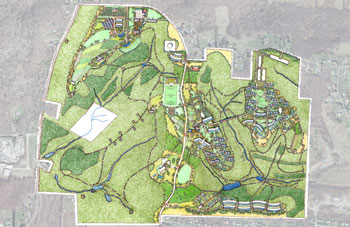 Chatham's Master Plan to develop the Eden Hall Campus in nearby Richland Township calls for the School of Sustainability and the Environment - the second of its kind in the U.S. - to be housed there on a 388 acre site north of the school's Shadyside Campus.
The new campus will be able to handle 100 students, which is expected to increase to 1,500 in the next decade, and will include four districts:
Mueller Center Campus-Restoration and preservation of existing facilities, construction of academic and residentail facilities and landscape restoration, with long range plans for an EcoCenter, commons building, greenhouse, agricultural fields, amphitheater, sports complex, constructed wetlands and art studio.
Elsalma Center-Interaction with the public on northwest corner of campus through a conference center, teaching kitchen, classrooms/workshops, orchard, farm market, aquaponics and wellness center.
Stanford Hill- Includess academic and residential buildings set in forest, streams and meadows.
Elizabeth Meadows- Includes parking facilities, townhomes for faculty, students and staff and additional constructed wetlands.
Friday, January 21, 2011
GVF is excited to launch its new program Commuter Challenge BINGO!
Looking for a fun and interactive way to change your commuting habits, and win some great prizes doing it? Sign up today for GVF’s Commuter Challenge Bingo, which we launched on January 3rd and goes until March 31, 2011!
Below GVF Project Manager, Carissa Bobenchik explains that the purpose of the Commuter Challenge is to improve mobility and sustain the environment by utilizing commuting alternatives. GVF encourages all residents of the Delaware Valley to walk, cycle, take transit, carpool, telecommute and/or utilize relevant commuter resources to make commuting easier and more sustainable.
Here’s how it works:
When you log onto Phillytraffic.com, click on 'How to Play' to register today! Each participant will receive an electronic bingo card in the form of a PDF that shows different commuting alternatives and ways to improve commuting overall. Once a participant “gets bingo” (completes all of the challenges in straight or diagonal line) they will submit the completed card to GVF. The first 10 participants to submit a completed card will win a prize.
We hope this Challenge exposes all participants to commuting alternatives, as well as different resources avaialble. Remember – you can make a difference in improving air quality, reducing congestion and enhancing mobility by making small changes in your daily commute!
Below GVF Project Manager, Carissa Bobenchik explains that the purpose of the Commuter Challenge is to improve mobility and sustain the environment by utilizing commuting alternatives. GVF encourages all residents of the Delaware Valley to walk, cycle, take transit, carpool, telecommute and/or utilize relevant commuter resources to make commuting easier and more sustainable.
Here’s how it works:
When you log onto Phillytraffic.com, click on 'How to Play' to register today! Each participant will receive an electronic bingo card in the form of a PDF that shows different commuting alternatives and ways to improve commuting overall. Once a participant “gets bingo” (completes all of the challenges in straight or diagonal line) they will submit the completed card to GVF. The first 10 participants to submit a completed card will win a prize.
We hope this Challenge exposes all participants to commuting alternatives, as well as different resources avaialble. Remember – you can make a difference in improving air quality, reducing congestion and enhancing mobility by making small changes in your daily commute!
Friday, January 7, 2011
Getting Back on Track - Climate Change & State Transportation Policy

State transportation policy has the potential to significantly reduce greenhouse gas emissions while also effectively meeting the nation's wide-ranging mobility needs. Few studies have specifically sought to evaluate how states' transportation policies impact greenhouse gas emissions. The NRDC evaluates how well state-level transportation decisions are aligned with efforts to reduce greenhouse gas emissions by examining a selection of key transportation policies currently in place in the 50 states. The findings suggest that there is tremendous potential to make progress on reducing transportation-related carbon emissions. The recommendations in this report suggest ways states can improve their climate performance while meeting their mobility needs.
Evaluating States' Policies to Curb Emissions from the Transportation Sector
This analysis evaluates each state based on 17 policy and spending criteria that have been compared by expert analysis to achieve transportation sector greenhouse gas reductions. States can also implement these criteria independent of local or federal action and each criterion has successfully been adopted in one or more states. The selected evaluation criteria fall into three categories:
1. Infrastructure Policies
2. Investment Decisions
3. Touchstone Policies
The total score and individual Policy, Investment, and Touchstone subtotals for each state can be found in the table. To give additional context to these numbers, each state is further categorized into three scoring tiers as defined below:
Tier 1 (75 - 100):
Most alignment between transportation policy with climate change goals. These states are leading the way in setting transportation policies that support greenhouse gas emissions reduction. However, even these states must strive to do more to support a truly sustainable transportation system.
Tier 2 (25 - 74):
Some alignment between transportation policy and climate change goals. These states are taking some actions that will support greenhouse gas reduction goals, but there are many actions they are not taking. They must do more to get on the right track.
Tier 3 (0 - 24):
Limited or no alignment between transportation policy and climate change goals. Though these states' transportation policies may support climate change goals in some very limited ways, this is countered by many of their other policy choices. Most of the potential to reduce emissions through transportation strategies remains underutilized.
To view the entire article by NRDC and see where Pennsylvania ranks, click here.
Wednesday, December 22, 2010
CONGRESS PASSES TRANSIT BENEFIT PARITY EXTENSION
Two weeks ago, I reported that GVF was working diligently to ensure the transit benefit parity was extended to remain at $230 per month. I'm happy to report that on December 16th, Congress completed work on an extension of the Bush/Middle class tax cuts and included, as a part of that package, is a provision extending parity between the transit/vanpool and parking portion of the transportation fringe benefit at a level of $230/month for 1-year. The transit benefit was set to be reduced to $120/month on January 1st, with this action; the transit benefit will stay at $230/month until at least the end of 2011.
“We would like to thank all of our fellow transit advocates who were able to help us convince our elected officials that this benefit is critical for those who take public transit. We were very active in helping to get the benefit changed in the first place as all we wanted was to have equality with those who pay for parking. We will continue to advocate for this important benefit as the long term goal is to make this a permanent benefit,” said Rob Henry, GVF Executive Director.
GVF, along with its partners the Association for Commuter Transportation (ACT), American Public Transportation Association (APTA), Delaware Valley Regional Planning Commission (DVRPC) and VPSI, has worked diligently to ensure this parity was extended. GVF has been working with its local delegation by submitted letters of support to the below legislators asking them to support the transit parity extension. We would like to extend our appreciation to them for their continued support.

• U.S. Senator Casey
• U.S. Senator Specter
• Congressman Gerlach
• Congresswoman Schwartz
• Congressman Sestak
“We would like to thank all of our fellow transit advocates who were able to help us convince our elected officials that this benefit is critical for those who take public transit. We were very active in helping to get the benefit changed in the first place as all we wanted was to have equality with those who pay for parking. We will continue to advocate for this important benefit as the long term goal is to make this a permanent benefit,” said Rob Henry, GVF Executive Director.
GVF, along with its partners the Association for Commuter Transportation (ACT), American Public Transportation Association (APTA), Delaware Valley Regional Planning Commission (DVRPC) and VPSI, has worked diligently to ensure this parity was extended. GVF has been working with its local delegation by submitted letters of support to the below legislators asking them to support the transit parity extension. We would like to extend our appreciation to them for their continued support.
• U.S. Senator Casey
• U.S. Senator Specter
• Congressman Gerlach
• Congresswoman Schwartz
• Congressman Sestak
Subscribe to:
Posts (Atom)